Joint Attention in Autism: Why It Matters and How ABA Builds It

In short: Joint attention is the ability to share focus on an object or event with another person. It is a foundational social skill that many autistic children need support to develop. ABA therapy uses structured, data-driven methods like prompting and reinforcement to teach joint attention, helping children engage more fully with others. A free matching service like ABA Care Near Me can connect you with a vetted, BCBA-led provider to start building this critical skill.
Key takeaways
- Joint attention is the shared focus between two people on an object or event, essential for communication and social bonding.
- Many autistic children struggle with joint attention, which can delay language and social development.
- ABA therapy uses evidence-based techniques like discrete trial training and natural environment teaching to build joint attention.
- Early intervention in joint attention can lead to improvements in spontaneous communication and peer interaction.
What Is Joint Attention?
Joint attention is the shared focus of two people on an object, event, or idea. It is more than just looking at the same thing - it involves an awareness that you and another person are attending to it together. The classic example is a child pointing to a passing truck, then looking back at a parent to share the moment. Three core components are typically present: eye contact (checking in), a gesture (pointing, showing, or offering), and a shared emotional response (smiling, laughing).
Joint attention differs from simple shared attention because it includes the social component of coordinating with the other person. It emerges naturally in most infants around 9-12 months, but for many autistic children, this skill may develop later or look different. Understanding this difference is the first step in supporting a child's development.
🔗 Related reading: What Is ABA Therapy? A Parent's Complete Guide · Find ABA Near Me
Why Is Joint Attention a Foundational Skill?
Language and Communication
Joint attention is closely linked to language development. When a child can share focus with a caregiver, they are more likely to learn new words because they can follow the adult's gaze or point and associate the label with the object. Research shows that early joint attention skills predict later vocabulary size and expressive language outcomes. Without these skills, a child may miss many opportunities to learn communication in natural contexts.
Social Interaction and Play
Social play relies heavily on joint attention. Games like peek-a-boo, rolling a ball back and forth, or building with blocks together all require a child to coordinate attention with a partner. Imitating others, a key part of learning and bonding, also depends on joint attention. When children cannot easily share focus, they may prefer solitary play, which can limit opportunities for peer interaction and friendship building.
Learning and Cognitive Development
Joint attention is not just about social fun - it is a powerful learning tool. A child who can attend to what a teacher is pointing at can absorb more information in a classroom. Joint attention supports theory of mind (understanding others' perspectives) and executive function skills like shifting focus. It is considered a pivotal skill because improvements in joint attention often lead to broader gains in communication and social behavior.
How Does Autism Affect Joint Attention?
Many autistic children show differences in joint attention from an early age. They may be less likely to initiate pointing or to follow another person's gaze. Some may look at an object they are interested in but not check back with a caregiver to share the experience. It is important to frame this not as a deficit but as a neurotype difference. Autistic children often have intense focus on their own interests and may not see the immediate value in coordinating attention with another person. Respecting that difference while gently teaching the skill is key.
ABA therapy takes a neurodiversity-affirming approach by building on the child's strengths and interests. For example, if a child loves trains, a therapist might use a train toy to naturally prompt shared attention. The goal is not to force eye contact but to create motivating opportunities for the child to engage with others. Every child is unique, and a skilled BCBA will tailor strategies to the individual.
🔗 Related reading: Is ABA Right for Your Child? Key Signs to Watch For · Find ABA Near Me
How ABA Therapy Builds Joint Attention
The Role of the BCBA
A Board Certified Behavior Analyst (BCBA) conducts a thorough assessment to determine the child's current joint attention skills. They identify what motivates the child, what types of prompts are needed, and how to break the skill down into small, teachable steps. A BCBA-led team then implements an individualized plan, collecting data continuously to track progress.
Creating Motivation through Reinforcement
ABA uses positive reinforcement to increase desired behaviors. For joint attention, the therapist might pair a highly preferred toy with a social interaction. For instance, the therapist holds a bubble wand, blows bubbles, and waits. When the child glances at the therapist after the bubbles pop, the therapist immediately blows more bubbles - reinforcing the shared moment. Over time, the child learns that coordinating attention leads to enjoyable experiences.
Prompting and Fading
Prompting helps the child succeed initially. A therapist might gently guide the child's hand to point to a picture, then gradually reduce the assistance. Prompts can be physical, gestural, or verbal. The key is to fade them quickly so the child responds independently. For example, the therapist might point to a toy and say, "Look!" then over sessions fade the verbal prompt to just a look.
Natural Environment Teaching (NET) vs. Discrete Trial Training (DTT)
Both approaches are used for joint attention. NET happens in natural settings - during play or daily routines - making the skill more meaningful. DTT is more structured, with repeated trials in a controlled setting. A balanced program often uses NET for generalization and DTT for initial teaching of specific components like following a point. Your provider will determine the right mix based on your child's needs.
Data Collection and Individualization
Every session includes data tracking: how often the child initiates joint attention, responds to bids, and for how long. This data guides decisions. If a child is not progressing, the BCBA adjusts the teaching strategy, reinforcement, or environment. This individualized approach is what makes ABA effective for building joint attention.
What to Expect in an ABA Session Targeting Joint Attention
A typical session might start with a preferred activity - for example, playing with a wind-up toy. The therapist winds it up, lets it go, and pauses. If the child looks at the therapist after the toy stops, the therapist winds it again while saying, "You saw that!" The therapist might also model pointing and use simple language like "Look!" Sessions often include turn-taking games, picture books, and cause-and-effect toys.
Parents are encouraged to participate. The BCBA will coach you on how to practice at home: during snack time, on walks, or while playing. Consistency across settings accelerates progress. You will also learn to recognize your child's subtle attempts at joint attention, like glancing your way while playing.
Progress milestones vary, but you might see the child first responding to joint attention (e.g., following a point), then initiating it (e.g., pointing and checking back). Eventually, the skill generalizes to new people and environments - grandparents, playgrounds, preschool. The timeline depends on the child's age, prerequisite skills, and consistency of therapy.
Real-Life Outcomes and Milestones
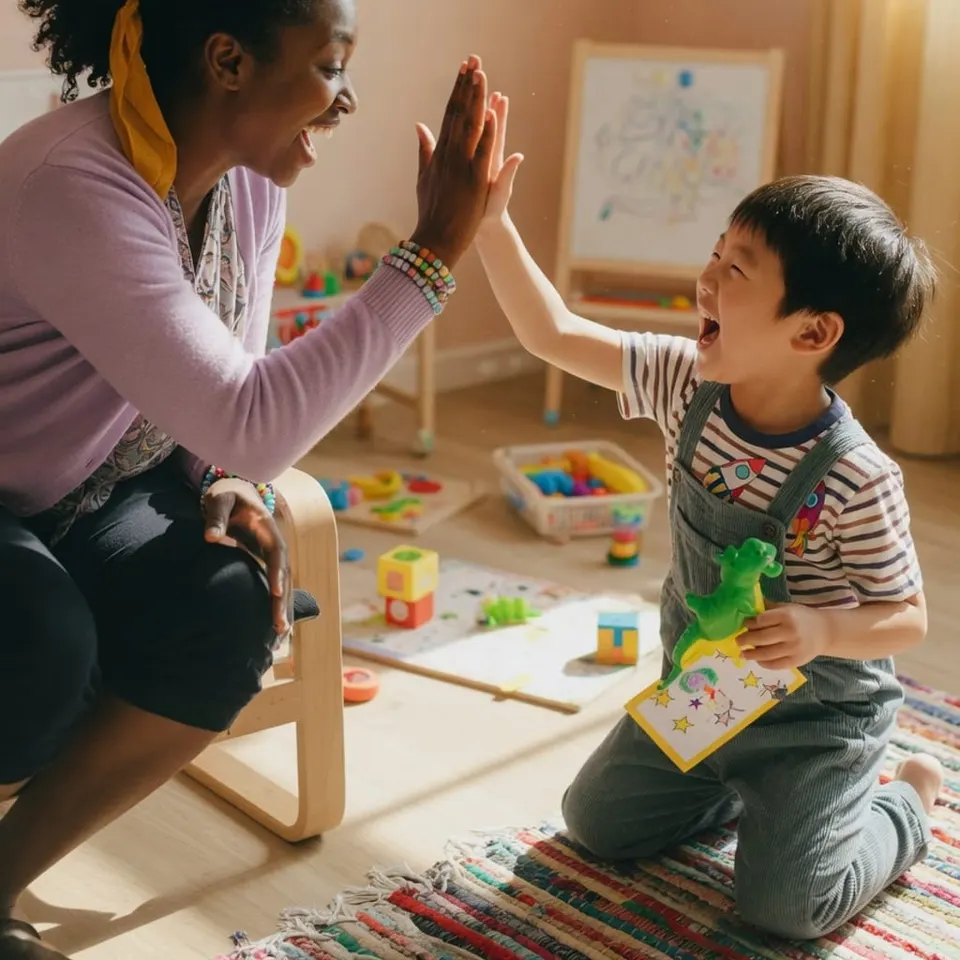
As joint attention improves, families often report that their child seems more connected. The child may initiate conversations, bring toys to show parents, or point out interesting sights. These small but powerful changes lay the groundwork for complex social interactions, imaginative play, and peer relationships. In school, a child who can share attention with a teacher is better positioned to learn in group settings.
Celebrating these milestones is important. Each increment - a look, a point, a shared laugh - is a victory. ABA therapy is not about making a child act neurotypical; it is about giving them tools to navigate a social world in ways that are comfortable and effective for them.
How to Find a Qualified ABA Provider
Finding a provider who specializes in joint attention and uses evidence-based, child-centered methods is crucial. That is where a free matching service like ABA Care Near Me comes in. You answer a few questions about your child's needs, location, and insurance, and the service connects you with vetted, BCBA-led providers in your area. These providers have experience with early intervention, joint attention, and play-based ABA.
Most commercial insurance plans, as well as Medicaid in many states, cover ABA therapy. The matching service can help verify your specific benefits and explain any copays or session limits. Starting early can make a significant difference, but it is never too late to begin building joint attention skills. Reach out to ABA Care Near Me today to get matched with a provider who can support your child's journey toward meaningful social connections.
Common Missteps to Avoid
- Expecting quick results: Joint attention is a complex skill that develops over months, not days. Celebrate small steps and trust the process.
- Using forced instruction: ABA should feel like play. Avoid drilling or demanding eye contact. Instead, create natural opportunities and follow the child's lead.
- Ignoring the child's interests: The most effective teaching happens when you join the child's world. If they are fascinated by spinning objects, use that to practice shared attention.
- Not generalizing across settings: Practice at home, in the park, at grandma's. A skill learned in one place won't automatically transfer without varied practice.
- Skipping parent training: Parents are the most consistent teachers. Make sure your provider includes parent coaching so you can reinforce skills throughout the day.
By avoiding these pitfalls and working with a skilled BCBA, you can help your child build joint attention in a way that respects their unique strengths and needs.